Introduction
Open source software has become a major part of modern business operations. Companies across industries rely on open source technologies to build applications, manage cloud infrastructure, improve scalability, reduce development costs and accelerate innovation. From start-ups to large enterprises, software teams regularly use publicly available frameworks, libraries and development tools to create products and services faster.
However, many organizations misinterpret the legal obligations linked with open source software. A common assumption is that software accessible online for free use carries no legal limitations. In reality, the open source software remains protected by copyright law. Businesses can use the software only under the conditions stated in the respective open source license.
As organizations increasingly depend on complex software ecosystems, copyright compliance has become a significant business concern. Companies that fail to manage open source obligations appropriately may face legal consequences, operational disruption, financial losses and damage to reputation.
Understanding Open Source Software
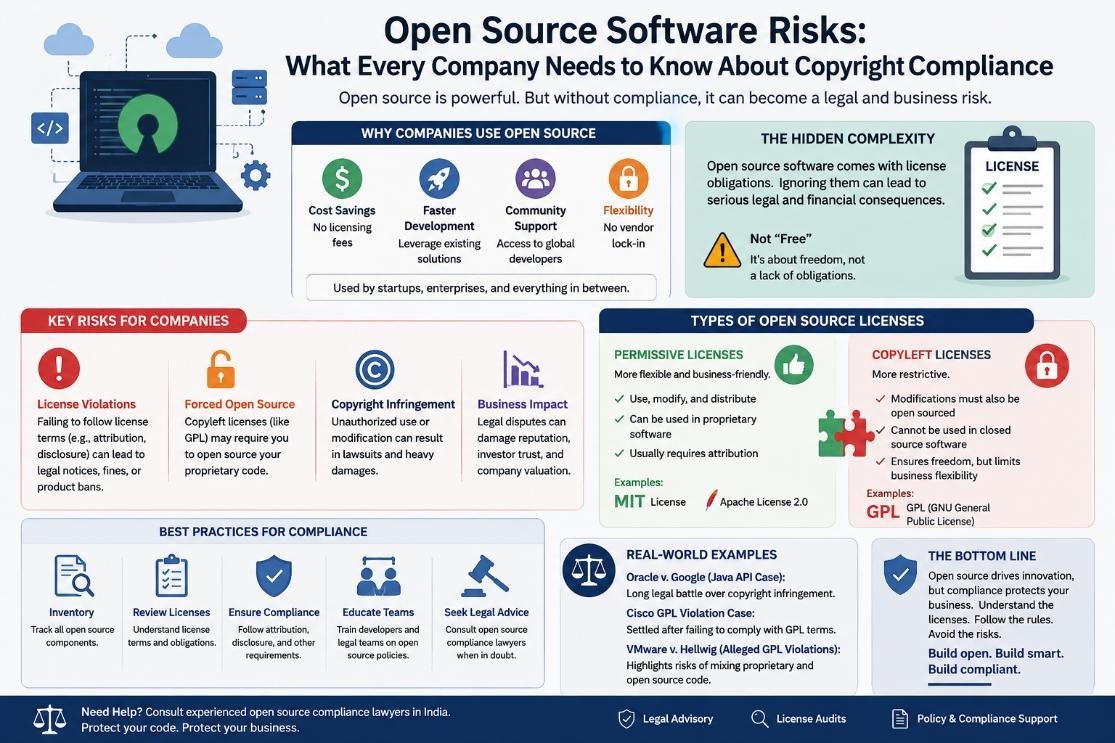
Open source software refers to software whose source code is publicly accessible for use, modification and distribution under specific licensing terms. The source code is the essential programming language that developers use to build software applications. Unlike proprietary software, where the source code remains private, open source software allows broader public accessibility. However, this does not mean the software has no owner. Copyright ownership still belongs to the original creators. Open source licenses merely grant permission for others to use the software under certain restrictions.
These licenses control how software may be copied, modified, distributed and/ or integrated into commercial products. Different licenses create different obligations for organizations and users.
Types of Open Source Licenses
Some open source licenses are permissive in nature. Permissive licenses ordinarily allow businesses to use, modify and commercially distribute
software with relatively less restrictions. General examples include the MIT License, Apache License and BSD License.
Other licenses are reciprocal licenses, often called copyleft licenses. The GNU General Public License, commonly known as GPL, is one of the most prominent examples. Under GPL licenses, companies distributing modified versions of the software may be required to furnish the associated source code under the same license terms.
Many businesses face compliance issues as they fail to fully understand the responsibilities associated with different license types.
Copyright Compliance Risks
One of the biggest misunderstandings about open source software is that freely available software cannot create copyright problems. In fact, copyright infringement may occur when organizations violate license conditions. For instance, companies may fail to preserve attribution notices, remove copyright information and/ or distribute software without complying with source code disclosure obligations.
License violations can expose businesses to lawsuits, injunctions, contractual disputes and financial penalties. In certain circumstances, organizations may even be restrained from distributing products until compliance issues are resolved.
Compliance failures can also affect business transactions. Investors and acquiring companies conduct open source audits during mergers and acquisitions. Further, many large customers require vendors to provide transparency regarding open source usage and software supply chain practices. If licensing problems are discovered, transactions may be delayed or become more expensive.
Hidden Risks in Modern Software Development
Modern software products are rarely built entirely from internally developed code. Engineering teams regularly use third party libraries, dependencies, application programming interface (APIs), cloud services, package managers and container images. A single software application may contain hundreds or even thousands of open source components. Many of these components include additional dependencies that developers may not even realize exist.
Package managers such as npm, pip, and Maven allow developers to install software libraries quickly. While these tools improve efficiency, they also increase compliance risk because developers may add components without legal review or proper documentation.
Publicly available container images create additional complexity. Organizations may deploy software infrastructure without fully understanding the underlying licensing obligations. Development repositories also create risk when engineers copy code from public sources without verifying ownership or license terms.
Software Supply Chain and AI Risks
Software supply chain management has become a major concern for businesses worldwide. Organizations often struggle to maintain visibility into all the open source components used across their systems. This lack of visibility creates both legal and cyber-security exposure. Companies may not
know where vulnerable or restricted software components exist within their infrastructure.
Artificial intelligence generated code introduces new ambiguity as well. AI coding tools may generate software code based on large scale training data but questions remain regarding copyright ownership and licensing obligations. In some cases, AI generated output may resemble existing open source projects. Businesses using AI assisted development tools must, therefore, carefully evaluate software origin and compliance obligations.
Real World Business Consequences
Open source compliance failures often create practical business problems rather than purely legal disputes. A start-up preparing for enterprise sales may discover that developers unknowingly integrated restrictive open source components into proprietary software. As a result, customer negotiations may be delayed while legal reviews are conducted.
A mid-sized technology company undergoing acquisition may face valuation concerns if due diligence reviews uncover undocumented software dependencies or license conflicts. Large enterprises may struggle to identify affected systems during cyber-security incidents because they lack centralized visibility into software components across business units.
These situations demonstrate that weak governance can affect operations, commercial strategy, investor confidence and customer relationships.
Building an Effective Compliance Program
Organizations must establish structured governance frameworks to manage open source risks effectively.
A strong compliance program should include internal policies defining how open source software may be approved, documented and distributed.
Developer education is critical because many compliance failures result from lack of awareness rather than intentional misconduct. Engineering teams should understand licensing obligations, attribution requirements and source code disclosure risks.
Compliance Lawyers should work closely with developers, procurement departments, security teams and executive leadership. Open source governance cannot succeed if handled only by one department.
Software composition analysis tools are increasingly important for identifying dependencies, monitoring licenses and detecting vulnerabilities. Automated tracking systems help organizations maintain visibility across large software environments.
Cross functional collaboration is equally important. Engineering teams understand technical architecture, legal teams understand licensing obligations, security teams manage vulnerabilities and procurement teams oversee vendor relationships.
Regular compliance audits also help companies identify problems early before they escalate into major legal or operational issues.
Different Challenges for Different Businesses
Startups often prioritize speed and rapid growth, which can lead to weak compliance practices. However, startups are particularly vulnerable during investor reviews and acquisition due diligence.
Mid-sized businesses usually face growing complexity as operations expand. They often require more formal governance processes and automated compliance tools.
Large enterprises manage the most complex environments because they operate across multiple regions, products and technology systems. These organizations often implement centralized governance programs and dedicated compliance teams.
Future of Open Source Governance
Regulators, customers, and enterprise buyers increasingly expect software supply chain transparency.
Software bill of materials requirements are becoming more common across industries. Businesses are expected to maintain clear inventories of software components and dependencies.
Cybersecurity regulations are also increasing pressure on organizations to improve software governance practices.
Artificial intelligence assisted software development will likely create additional legal uncertainty regarding ownership and licensing obligations.
As digital ecosystems continue evolving, businesses that fail to adapt may face increasing legal, operational and commercial risk.
Conclusion
Open source software offers enormous advantages for modern businesses, including faster innovation, reduced development costs and greater scalability. However, these benefits come with important legal and operational responsibilities.
Companies that misunderstand open source licensing obligations expose themselves to copyright infringement claims, compliance failures, operational disruption and reputational harm.
Modern software environments are becoming increasingly complex due to third party dependencies, cloud infrastructure, artificial intelligence tools and global software supply chains. As a result, proactive governance is now essential.
Organizations that invest in compliance programs, developer education, software visibility tools and cross functional collaboration can continue benefiting from open source innovation while reducing legal and operational exposure.
Open source copyright compliance is no longer simply a technical issue. It is now a critical business governance requirement that directly affects enterprise value, customer trust, cyber security resilience and long term commercial success.